As global energy systems, aerospace technology, and industrial gas networks rapidly evolve, managing ultra-low-temperature fluids has become a critical operational requirement. Handling media at sub-zero temperatures presents extreme engineering challenges that standard process hardware simply cannot endure.
At ISIS Process, a specialized division of ISIS Fluid Control, we pair deep technical consultation with world-class manufacturing partnerships to deliver safe, highly reliable fluid control systems for extreme environments. Here is what you need to know about cryogenics, why ultra-cold liquids are essential to modern industry, and how our Vinco Cryogenic Range (CXF, CCF, and CQF) delivers complete isolation and flow control down to -196°C.
What is Cryogenics?
In industrial engineering, cryogenics refers to the production, storage, and handling of materials at temperatures below -150°C (-238°F). At these extreme temperatures, common atmospheric gases—such as nitrogen, oxygen, argon, methane, and hydrogen—condense from gas into liquid state.
Common cryogenic fluids include:
-
Liquefied Natural Gas (LNG): Methane liquefied at approximately -162°C.
-
Liquid Nitrogen (LN2): Liquefied at -196°C, widely used for industrial cooling and freezing.
-
Liquid Oxygen (LOX): Liquefied at -183°C, essential for aerospace propulsion and steelmaking.
-
Liquid Hydrogen (LH2): Liquefied at -253°C, representing the ultra-deep cryogenic tier for clean power and space flight.
Working with cryogenic fluids requires specialized thermal design because materials behave dramatically differently at sub-zero limits—metals contract, standard elastomers lose elasticity and shatter, and trapped liquids can rapidly expand with explosive force if heated.
Why Are People Using Cryogenic Liquids?
The primary driver for converting gases into cryogenic liquids is volumetric efficiency:
-
Massive Volume Reduction: Liquefied Natural Gas (LNG), for example, takes up roughly 1/600th of the volume of methane gas at ambient temperature and atmospheric pressure. Liquid storage allows massive quantities of energy or industrial gas to be stored, transported, and shipped economically across oceans without massive gas pipelines.
-
High Energy Density: Cryogenic storage provides maximum payload density for transportation fuels, rocket propellants, and heavy energy reserves.
-
Rapid Cooling Power: Cryogenic liquids act as powerful direct-contact refrigerants for high-speed manufacturing, biological preservation, and chemical crystallization.
What Industries Use Cryogenic Fluids?
Cryogenic processes form the backbone of several high-value global industries:
-
Energy & LNG Logistics: Import/export terminals, peak-shaving plants, LNG bunkering facilities, and regasification skids.
-
Aerospace & Defense: Liquid rocket propulsion systems using liquid oxygen (LOX) and liquid hydrogen (LH2) or LNG.
-
Industrial Gases & Air Separation Units (ASUs): Production plants that fractionate atmospheric air into high-purity nitrogen, oxygen, and argon.
-
Pharmaceuticals & Biotechnology: Cold-chain storage, cryopreservation of biological samples, and low-temperature chemical synthesis.
-
Semiconductor & Electronics Fabrication: Ultra-high purity liquid gases used in chip manufacturing and cleanroom processing.
-
Food Processing & Metallurgy: Cryogenic flash-freezing, food preservation, and deep thermal treatment of metals to improve structural wear resistance.
Why Are Valves Important to Cryogenic Systems?
In sub-zero liquid lines, standard industrial valves will fail quickly, risking structural damage, severe stem leakage, and catastrophic line over-pressurization.
Cryogenic valves must incorporate specialized engineering features to solve five major cold-temperature hazards:
-
Stem Packing Freeze Protection (Extended Bonnets): When a valve operates at -196°C, cold thermal conduction travels up the valve stem. Cryogenic valves utilize an extended bonnet (drip tray column) to distance the stem packing from the cryogenic liquid. The gas column inside the extension acts as an insulating vapor cushion, ensuring the gland packing remains warm enough to maintain a flexible, leak-tight seal.
-
Thermal Contraction & Seat Binding: Metals contract significantly at cryogenic temperatures. Valves must be designed with materials that match thermal expansion coefficients, combined with resilient soft seating (such as TFM1600 or PCTFE) to prevent thermal binding or seat leakage.
-
Trapped Cavity Over-Pressurization: Cryogenic liquids trapped inside a closed valve body cavity will warm up when isolated. As the liquid vaporizes into gas, the internal pressure ratio expands exponentially (up to 600:1). Cryogenic ball valves must feature upstream pressure-relief mechanisms or self-relieving seats to safely vent trapped pressure back into the high-pressure pipeline.
-
Material Embrittlement: Carbon steel and low-grade metals become brittle and prone to sudden fracture at ultra-low temperatures. Cryogenic valve bodies are constructed from austenitic stainless steels (such as A351 CF8M / CF3M) or specialized nickel alloys that retain ductile strength down to -196°C.
-
Degreasing & Cleanliness: Cryogenic valves used in oxygen service (LOX) must be thoroughly degreased and hydrocarbon-cleaned to prevent catastrophic combustion upon contact with pure liquid oxygen.


VINCO CCF | ANSI CRYOGENIC FLANGED BALL VALVE
VINCO CCF | DIN CRYOGENIC FLANGED BALL VALVE
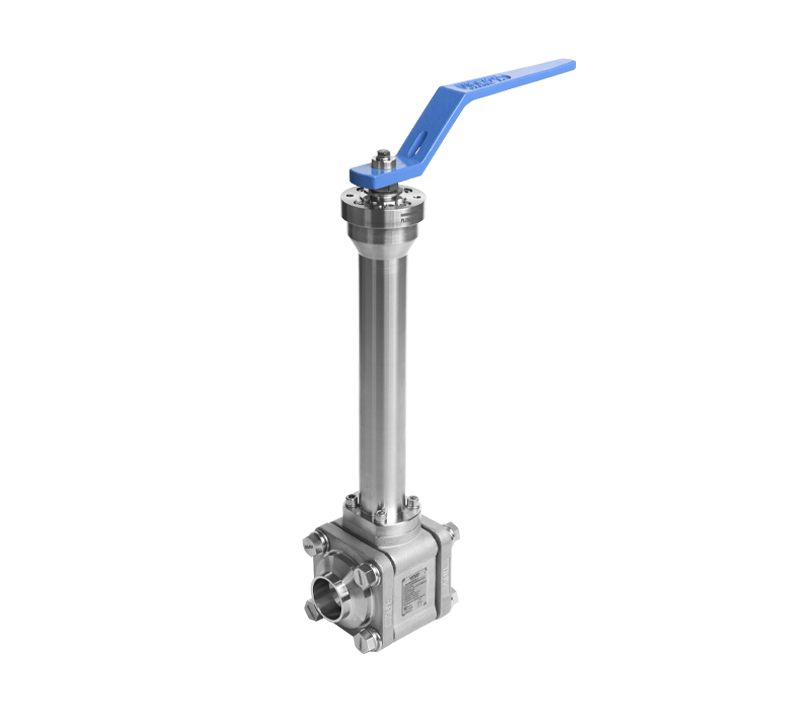
VINCO CXF | CRYOGENIC 3 PIECE BALL VALVE
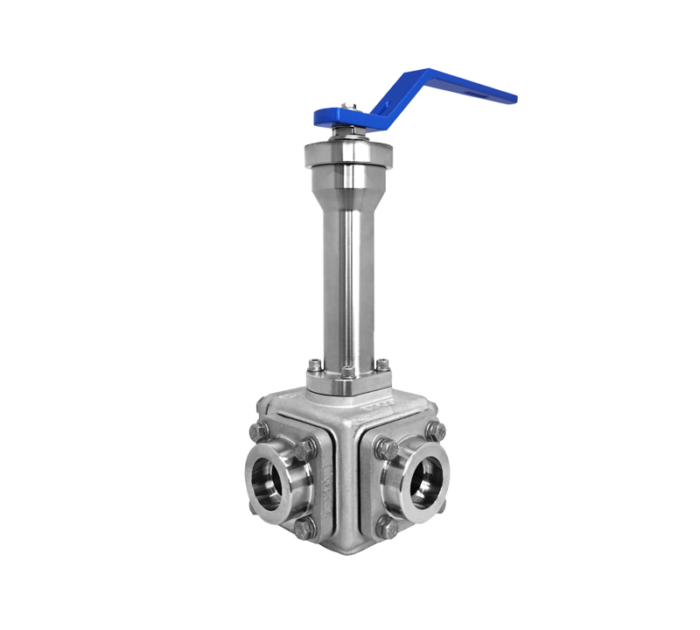
VINCO CQF | DIN CRYOGENIC MULTI-PORT BALL VALVE
Why ISIS Process and Vinco Valves Are the Best Choice
Selecting valves for cryogenic service requires absolute material traceability, technical expertise, and precision engineering.
The Vinco Cryogenic Range: CXF, CCF, & CQF
To address the challenges of sub-zero process control, ISIS Process supplies the Vinco Cryogenic Range—engineered specifically for reliable shut-off, zero stem leakage, and safety compliance in extreme cold applications down to -196°C:
-
Vinco CXF Series (3-Piece Cryogenic Ball Valve): Designed for compact pipelines, skids, and welded systems up to ASME Class 600. The CXF features a 3-piece bolted body layout with an extended bonnet column, live-loaded stem packing, and an integrated upstream relief hole. A unique rib-and-groove fool-proof alignment system ensures the unidirectional safety relief feature is always installed in the correct flow orientation.
-
Vinco CCF Series (Flanged Cryogenic Ball Valve): Built for split-body flanged piping networks available in ASME CL150/CL300 and DIN PN16/PN40 configurations. Incorporating TFM1600 or PCTFE soft seats, double-encapsulated body sealing, and BS 6364 cryogenic extension bonnets, the CCF Series provides reliable primary isolation for bulk storage tanks, LNG plants, and gas transport infrastructure.
-
Vinco CQF Series (Multi-Port Cryogenic Ball Valve): A 3/4/5-way cryogenic floating ball valve engineered for complex flow-diverting and multi-directional switching networks down to -196°C. Available with “L”, “T”, or “X” port configurations and pressure ratings up to ASME CL300/CL600, the CQF minimizes pipework complexity by replacing multiple standard isolation valves with a single multi-port cryogenic unit.
The ISIS Process Advantage
When you work with ISIS Process, you gain a partner that understands the technical realities of ultra-cold fluid handling:
-
Superior Technical Knowledge: Our engineering team provides application-specific advice on material selection, seat selection, NACE compliance, and cryogenic test standards (BS 6364 / ISO 28921).
-
In-House Design & Workshop Testing: Operating out of our Chipping Norton facilities, our workshop team provides 3D SolidWorks design modeling, custom actuator automation, hydrostatic testing, and gas testing to verify valve performance before dispatch.
-
Deep Inventory & Fast Turnaround: Supported by extensive UK stock depth, we deliver rapid turnarounds on standard and modified process valve packages to keep your projects running on schedule.
Whether you are configuring an LNG regasification skid, setting up liquid nitrogen supply lines, or specifying multi-port cryogenic manifolds, ISIS Process brings engineered precision to your sub-zero applications.
To consult with our technical team on your cryogenic valve specifications, contact sales@isisprocess.com or visit isisfluid.com today. Where solutions flow